Post
N95 vs KN95 Face Masks: Which Mask Offers Better Protection?
May
N95 vs KN95 Face Masks: Which Mask Offers Better Protection?
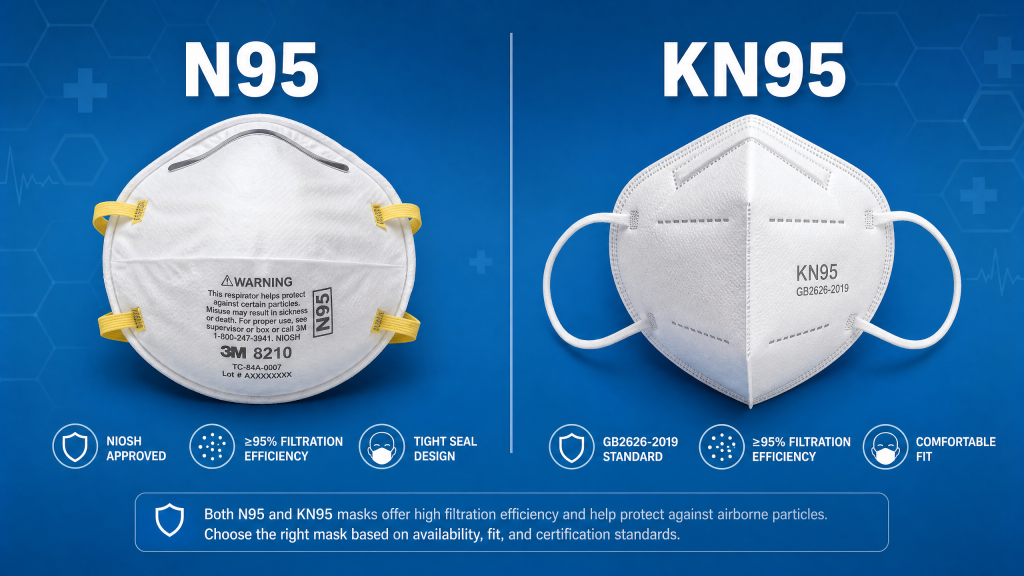
The debate surrounding N95 vs KN95 face masks has become increasingly important as consumers look for reliable respiratory protection in everyday life, workplaces, travel environments, and polluted urban areas. Both mask types are widely recognized for their high filtration efficiency, yet important differences exist in certification standards, fit, comfort, pricing, and quality control.
At first glance, N95 and KN95 masks appear very similar because both claim to filter at least 95% of airborne particles. However, understanding the real-world differences between N95 vs KN95 masks can help consumers choose the right option based on their personal needs, exposure level, and budget.
This comprehensive guide explains how both mask types work, compares their strengths and weaknesses, and helps you decide which mask offers the best protection for your situation.
Understanding the N95 vs KN95 Comparison
The key difference in the N95 vs KN95 discussion lies in the certification systems used in different countries.
- N95 masks follow United States standards regulated by NIOSH (National Institute for Occupational Safety and Health).
- KN95 masks follow Chinese standards regulated under the GB2626 standard.
Both standards require masks to filter at least 95% of non-oil airborne particles under laboratory testing conditions.
Despite this similarity, differences in manufacturing oversight, testing consistency, and fit standards create meaningful distinctions between N95 and KN95 masks in real-world use.
What Makes N95 Masks Different?
N95 respirators are widely considered the gold standard for respiratory protection in healthcare and industrial settings.
Strict Certification Standards
One major advantage in the N95 vs KN95 comparison is the strict NIOSH certification process. Every certified N95 mask must pass extensive laboratory testing before receiving approval.
NIOSH testing evaluates:
- Filtration efficiency
- Breathing resistance
- Structural integrity
- Strap durability
- Leakage performance
This strong oversight helps ensure consistent quality across certified N95 products.
Superior Seal and Fit
N95 masks are specifically designed to create a tight seal around the face.
Most N95 respirators use:
- Dual head straps
- Adjustable nose bridges
- Structured cup or fold designs
A secure seal is critical because even small gaps can allow unfiltered air to bypass the filtration material.
In the N95 vs KN95 comparison, fit consistency is one reason healthcare professionals often prefer N95 respirators.
High Filtration Efficiency
Certified N95 masks filter at least 95% of airborne particles measuring 0.3 microns under testing conditions.
These particles may include:
- Dust
- Smoke
- Pollen
- Bacteria
- Fine airborne contaminants
The electrostatically charged filtration layers in N95 masks help trap particles more effectively than ordinary fabric materials.
Understanding KN95 Masks
KN95 masks became extremely popular worldwide due to their accessibility and affordability.
Similar Filtration Claims
Like N95 masks, KN95 masks are designed to filter at least 95% of non-oil particles.
This similarity often causes confusion in the N95 vs KN95 discussion because consumers assume both products perform identically.
However, actual performance may vary depending on manufacturer quality and testing consistency.
Comfortable Design
Many users prefer KN95 masks because they often feature a foldable “boat-shaped” design that creates more breathing space around the mouth and nose.
This design can improve:
- Comfort
- Breathability
- Speaking clarity
- Long-term wearability
In daily use, some consumers find KN95 masks more comfortable than certain rigid N95 respirators.
Greater Availability and Lower Prices
One major advantage in the N95 vs KN95 market is cost and accessibility.
KN95 masks are generally:
- Easier to find
- More affordable
- Widely sold online
- Available in larger style varieties
This makes them attractive for regular everyday use.
Key Differences Between N95 vs KN95
Although both masks target similar filtration performance, important differences exist.
Certification Oversight
N95 masks undergo stricter U.S. regulatory oversight and certification testing.
KN95 standards are legitimate, but manufacturing consistency can vary more widely depending on the producer.
Strap Design
N95 masks typically use headbands, while KN95 masks commonly use ear loops.
Headbands generally create tighter facial seals, which may improve overall protection.
This is a significant distinction in the N95 vs KN95 fit comparison.
Fit Testing Requirements
In professional healthcare settings, N95 respirators often require formal fit testing.
KN95 masks are usually not fit-tested in the same way.
A proper seal dramatically affects real-world mask performance.
Counterfeit Product Risk
Counterfeit masks became a major issue during periods of high global demand.
In the N95 vs KN95 market, low-quality counterfeit KN95 products became especially widespread.
Consumers should purchase masks only from reputable suppliers.
Which Offers Better Protection: N95 vs KN95?
For maximum verified protection, certified N95 respirators generally hold the advantage.
Reasons include:
- Stricter certification standards
- Better fit consistency
- More reliable manufacturing oversight
- Reduced quality variability
However, properly manufactured KN95 masks from reputable companies can still provide excellent respiratory protection for everyday use.
The real-world effectiveness of both masks depends heavily on:
- Proper fit
- Authenticity
- Consistent wear
- Correct usage
Comfort Comparison: N95 vs KN95
Comfort is an important factor because uncomfortable masks are less likely to be worn consistently.
N95 Comfort
Some N95 masks may feel tighter due to stronger sealing pressure and headband tension.
However, modern N95 designs have improved significantly in breathability and comfort.
KN95 Comfort
Many users find KN95 masks more comfortable for long-term daily wear because of:
- Lighter pressure
- Ear loop design
- Flexible folding structure
- More internal breathing space
In the N95 vs KN95 comfort debate, KN95 masks often appeal to general consumers seeking everyday convenience.
N95 vs KN95 for Different Situations
Healthcare and High-Risk Environments
N95 respirators are usually preferred in:
- Hospitals
- Medical facilities
- High-exposure workplaces
- Airborne risk environments
Daily Public Use
KN95 masks are often sufficient for:
- Commuting
- Shopping
- Office work
- Public transportation
- General indoor protection
Travel and Crowded Spaces
Both mask types can perform well during travel, especially when properly fitted.
For long flights or crowded transportation systems, many travelers prefer N95 masks for stronger seal performance.
How to Verify Authentic N95 vs KN95 Masks
Authenticity is extremely important.
Verifying N95 Masks
Genuine N95 masks should include:
- NIOSH logo
- Approval number
- Manufacturer identification
- Proper packaging information
Consumers can also verify products using official NIOSH databases.
Verifying KN95 Masks
For KN95 masks, look for:
- GB2626 standard labeling
- Third-party testing reports
- Reputable manufacturers
- Transparent product documentation
Avoid suspiciously cheap products with unclear labeling.
Common Mistakes in the N95 vs KN95 Debate
Many consumers misunderstand how masks actually work.
Assuming All Masks Are Equal
Not all masks labeled N95 or KN95 are authentic or properly certified.
Ignoring Fit
Even the highest-rated mask performs poorly if gaps allow unfiltered air leakage.
Reusing Disposable Masks Excessively
Extended wear eventually reduces filtration efficiency and structural integrity.
Prioritizing Price Alone
Very cheap masks may sacrifice quality and protection.
Cost Comparison of N95 vs KN95
In general:
- N95 masks cost more
- KN95 masks are more affordable
The higher price of N95 respirators reflects:
- Rigorous certification
- Higher quality control standards
- Domestic manufacturing costs in many cases
Consumers must balance protection needs with budget considerations in the N95 vs KN95 decision.
The Future of N95 vs KN95 Respirators
Manufacturers continue improving both mask types through innovations such as:
- Better breathable materials
- Enhanced comfort designs
- Eco-friendly production methods
- Adjustable ergonomic sealing systems
- Lightweight filtration technologies
Future developments will likely reduce the comfort gap between N95 and KN95 masks while maintaining strong protection standards.
Conclusion: Choosing Between N95 vs KN95
The N95 vs KN95 comparison does not produce a single universal winner because both mask types serve valuable roles depending on the user’s needs.
N95 masks offer:
- Stronger regulatory oversight
- More consistent filtration performance
- Better sealing capability
- Trusted healthcare-level protection
KN95 masks provide:
- Greater affordability
- Improved accessibility
- Comfortable everyday wear
- Strong protection when authentic and properly fitted
Ultimately, the best choice depends on your environment, exposure risk, comfort preferences, and ability to verify product authenticity. Whether you choose N95 or KN95, proper fit, certified quality, and consistent use remain the most important factors in achieving effective respiratory protection.
