Post
Face Mask Filtration Ratings Explained: MERV, N95, FFP2, and More
May
Face Mask Filtration Ratings Explained: N95, FFP2, KN95, and More
Understanding face mask filtration ratings has become increasingly important for consumers, healthcare workers, travelers, and anyone concerned about respiratory protection. With dozens of mask types available worldwide, many people struggle to determine which masks provide genuine protection and which are simply marketing hype.
Different countries use different certification systems, which often creates confusion when comparing products. A mask labeled N95 in the United States may appear similar to an FFP2 mask in Europe or a KN95 mask in China, but the standards behind these certifications vary in testing methods, fit requirements, and quality control.
This guide explains the most common face mask filtration ratings, how they compare internationally, and how to choose the right mask for your needs.
Why Face Mask Filtration Ratings Matter
The purpose of face mask filtration ratings is to provide standardized information about how effectively a mask filters airborne particles. These ratings allow consumers to compare products objectively instead of relying solely on advertising claims.
Without certified filtration standards, it becomes difficult to know whether a mask offers reliable protection. Some masks may look identical but perform very differently in real-world conditions. Official certification systems help ensure consistency in manufacturing, testing, and safety performance.
The most important factor behind most face mask filtration ratings is the percentage of microscopic airborne particles the mask can filter under laboratory testing conditions. Higher ratings generally indicate stronger filtration performance, although comfort, fit, and breathability also matter.
American Face Mask Filtration Ratings: NIOSH Standards
In the United States, respirators are regulated by the National Institute for Occupational Safety and Health (NIOSH). NIOSH certifications are among the most recognized and trusted face mask filtration ratings worldwide.
N-Series Face Mask Filtration Ratings
The N-series is the most common category in American respirator standards. The letter “N” means the mask is not resistant to oil-based particles.
The three main N-series levels include:
- N95 – Filters at least 95% of airborne particles
- N99 – Filters at least 99% of airborne particles
- N100 – Filters at least 99.97% of airborne particles
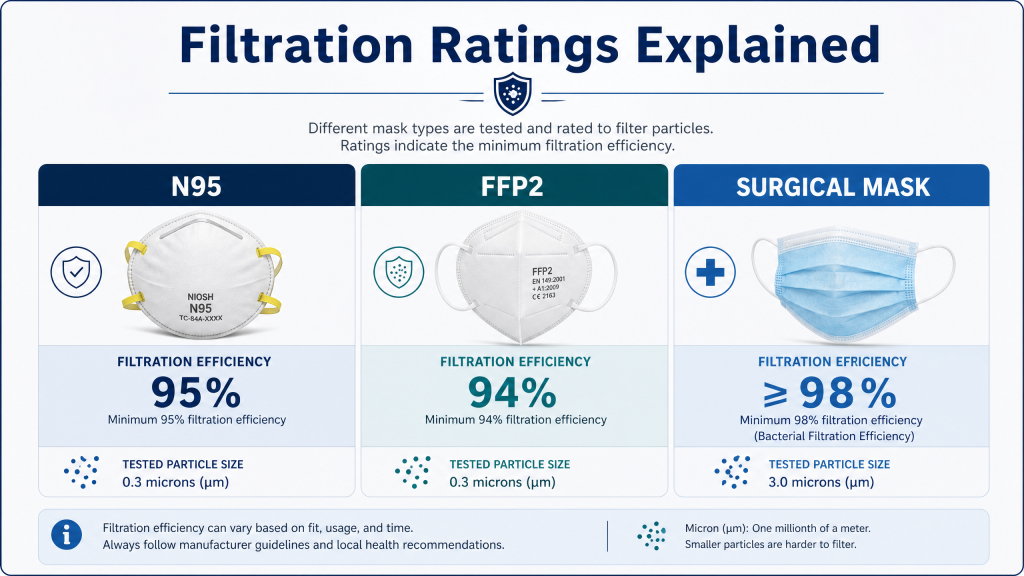
These respirators are tested using particles approximately 0.3 microns in size, which are considered among the most difficult particles to filter effectively.
Among all global face mask filtration ratings, N95 remains the most widely recognized because of its extensive use in healthcare and industrial environments.
R and P Series Respirators
NIOSH also includes R-series and P-series respirators for environments involving oil-based aerosols.
- R-Series – Resistant to oil for limited exposure
- P-Series – Oil-proof and suitable for extended exposure
These masks are more commonly used in industrial settings such as spray painting, chemical manufacturing, and machining operations.
While these specialized face mask filtration ratings are less common for everyday public use, they remain important in occupational safety industries.
European Face Mask Filtration Ratings: FFP Standards
European respirators follow the EN149 standard and use the FFP classification system. FFP stands for “Filtering Face Piece.”
The European system contains three primary levels of face mask filtration ratings.
FFP1 Face Mask Filtration Ratings
FFP1 masks are the lowest protection tier in Europe. They filter at least 80% of airborne particles and are generally intended for low-risk environments involving dust or non-toxic particles.
These masks are not typically recommended for protection against airborne viruses or hazardous aerosols.
Because of their limited performance, FFP1 face mask filtration ratings are primarily used in construction, sanding, or basic industrial tasks.
FFP2 Face Mask Filtration Ratings
FFP2 respirators filter at least 94% of airborne particles and are often considered the European equivalent of N95 masks.
FFP2 masks became especially popular throughout Europe during respiratory disease outbreaks because they provide strong protection while maintaining reasonable comfort and breathability.
For most public health situations, FFP2 represents one of the most practical face mask filtration ratings available for daily use.
FFP3 Face Mask Filtration Ratings
FFP3 masks provide the highest level of respiratory protection under European standards. They filter at least 99% of airborne particles and are commonly used in medical procedures, laboratory environments, and hazardous industrial applications.
These respirators are designed for situations where maximum filtration efficiency is essential.
Among European face mask filtration ratings, FFP3 offers the strongest certified protection.
Chinese Face Mask Filtration Ratings: KN95 and KP Standards
China uses the GB2626 standard for respirators. The most common classifications are KN and KP.
KN95 Face Mask Filtration Ratings
KN95 masks are designed for non-oil-based particles and must filter at least 95% of airborne particles.
In theory, KN95 masks are roughly equivalent to N95 respirators in filtration efficiency. However, certification procedures and enforcement standards can vary significantly between manufacturers.
During periods of high global demand, counterfeit and poorly manufactured KN95 masks entered the market, making verification especially important when purchasing masks with these face mask filtration ratings.
KP-Series Respirators
KP-series masks are designed for environments containing oil-based particles. They are more commonly used in industrial sectors rather than public health applications.
Although less familiar to general consumers, KP classifications remain an important part of global face mask filtration ratings systems.
Surgical Mask Face Mask Filtration Ratings
Unlike respirators, surgical masks are primarily designed to block droplets and fluid splashes rather than create a tight facial seal.
In the United States, surgical masks are commonly tested under ASTM standards.
ASTM Level 1, 2, and 3 Ratings
ASTM surgical mask standards include three protection levels:
- Level 1 – Low fluid exposure protection
- Level 2 – Moderate fluid exposure protection
- Level 3 – High fluid exposure protection
These classifications evaluate several factors, including bacterial filtration efficiency, breathability, and fluid resistance.
Although ASTM certifications differ from respirator-based face mask filtration ratings, they still provide useful information for medical and public health applications.
Comparing Face Mask Filtration Ratings Around the World
One of the biggest challenges consumers face is understanding how international standards compare.
The following respirators are generally considered similar in filtration performance:
| Region | Standard |
|---|---|
| United States | N95 |
| Europe | FFP2 |
| China | KN95 |
| Australia/New Zealand | P2 |
| Korea | KF94 |
Although testing procedures differ slightly, these standards all provide high-level respiratory protection for airborne particles.
Understanding global face mask filtration ratings allows consumers to confidently purchase certified masks from international suppliers when domestic products are unavailable.
Cloth Masks and Non-Certified Protection
Cloth masks typically do not carry official certification because they are not usually regulated as medical devices or industrial respirators.
However, studies have shown that material choice and mask construction significantly affect filtration performance.
Factors influencing cloth mask effectiveness include:
- Number of fabric layers
- Fabric density
- Fit around the face
- Presence of filter inserts
- Moisture resistance
Some high-quality cloth masks with PM2.5 filters can provide decent particle filtration, although they generally do not achieve the performance levels of certified respirators.
Since cloth masks lack formal face mask filtration ratings, buyers should focus on reputable brands, independent testing, and proper fit.
How Fit Affects Face Mask Filtration Ratings
Even the highest-rated mask may fail to provide adequate protection if it does not fit correctly.
Air naturally follows the path of least resistance. If gaps exist around the edges of a mask, contaminated air can bypass the filter entirely.
Important fit considerations include:
- Adjustable nose bridges
- Tight but comfortable seal
- Proper strap tension
- Minimal side gaps
- Correct sizing
This is why professional respirators often undergo fit testing in healthcare and industrial environments.
When evaluating face mask filtration ratings, remember that laboratory performance only applies when the mask seals properly against the face.
How to Verify Certified Face Mask Filtration Ratings
Counterfeit products became a major issue during periods of high mask demand. Many masks falsely claimed N95 or KN95 certification despite failing safety tests.
To verify authenticity:
- Check certification markings on the mask
- Research the manufacturer
- Confirm approval numbers through regulatory databases
- Avoid unusually cheap bulk products
- Purchase from trusted suppliers
Legitimate manufacturers provide detailed testing information and certification documentation.
Verifying official face mask filtration ratings helps ensure that the product delivers the advertised level of protection.
Choosing the Right Face Mask for Your Needs
Different situations require different levels of protection.
Everyday Public Use
For general public environments such as shopping centers, public transportation, or offices, masks equivalent to N95, KN95, KF94, or FFP2 typically provide strong respiratory protection.
Healthcare Settings
Medical professionals and caregivers often require respirators with certified high-performance face mask filtration ratings because of prolonged exposure to infectious particles.
Industrial Environments
Workers exposed to dust, chemicals, or oil-based aerosols may require specialized R-series, P-series, or FFP3 respirators depending on workplace hazards.
Low-Risk Situations
In lower-risk outdoor environments, well-constructed cloth masks may still provide useful protection and comfort.
Conclusion: Understanding Face Mask Filtration Ratings
Learning how face mask filtration ratings work makes it easier to navigate the overwhelming number of mask products available worldwide. Certifications such as N95, FFP2, KN95, and KF94 provide valuable information about filtration performance, testing standards, and intended use.
While filtration efficiency is important, proper fit, authenticity, comfort, and intended environment also play critical roles in overall protection. A well-fitted certified mask from a trusted manufacturer generally provides far better protection than an uncertified alternative with misleading marketing claims.
By understanding international standards and verifying legitimate certifications, consumers can make informed decisions and choose masks that genuinely match their protection needs.
